Wind gusts up to 30 mph are predicted to hit the Rogue Valley this afternoon as a strong cold front moves through the area. Rain will likely start tonight and continue as showers into Saturday.
While open burning is allowed in Josephine County today, residents are advised to monitor their burn pile fires closely and extinguish their fires if winds start to increase.
In the Cascades and Siskiyous, winds could hit 45 mph and the snow level is expected to drop to 3500 feet tonight.
Travelers crossing the passes will want to plan for wet snow, and the newly opened Bear Camp Rd, which crosses the Siskiyous between Galice and Gold Beach, may get 3-6 inches of new snow.
SWOFIRE
Oregon Department of Forestry
Southwest Oregon District
Tuesday, May 21, 2013
Wednesday, May 15, 2013
It Isn't Fire Season Yet, But It's Getting Nearer
Cooler temperatures this week and a prediction for showers through the weekend has stalled discussions about starting fire season on ODF's Southwest Oregon District -- at least for a few more days. However, fire season has begun on lands to the north that are protected by the Douglas Forest Protective Association and on ODF's Klamath-Lake District, east of the Cascades.
But just because fire season is not yet in effect in Jackson and Josephine counties does not mean wildfires cannot burn. Thunderstorms May 5-7 sparked 23 small fires on the district (14 in the Grants Pass Unit and 9 in the Medford Unit) and grass fires caused by open burning occur several times a week.
Use care when burning debris and when using power-driven equipment where there is dry grass or brush.
But just because fire season is not yet in effect in Jackson and Josephine counties does not mean wildfires cannot burn. Thunderstorms May 5-7 sparked 23 small fires on the district (14 in the Grants Pass Unit and 9 in the Medford Unit) and grass fires caused by open burning occur several times a week.
Use care when burning debris and when using power-driven equipment where there is dry grass or brush.
Wednesday, May 8, 2013
Fire Season Readiness on Oregon's State and Private Forestlands
Those who insist on a forecast of the wildfire season should
ask for something easier, like who will win the American League pennant. But
this we do know: Some sizable fires have already occurred and more are expected
as warm, dry weather begins to take hold. The Oregon Department of Forestry
(ODF) and its partner agencies are completing final preparations for the
season, however it shapes up. ODF continues to ensure that the essential
elements are in place: helicopters and air tankers, fire engines, hand crews,
and three specially trained teams to manage large wildfires.
Air attack
Helicopters are the vanguard of the firefighting force.
These ships - large, medium and small - provide close-in support to
ground-based fire crews. With precision drops from their water buckets,
experienced pilots can steer a flame front away from timber and houses. Eight
helicopters will fly under contract to ODF and the fire protective associations
in 2013.
Yesterday’s airliners do the heavy lifting in today’s air
attack on fires. Two converted DC-7 passenger planes, the seats replaced with
large tanks, deliver liquid fire retardant to slow the flames’ advance. The
propeller-driven aircraft turn double-digit airspeed into a virtue as they fly low and slow over rugged terrain, cooling hotspots to buy
time for ground firefighters to arrive on scene and engage the fire directly.
Seven smaller fixed-wing aircraft play a dual role of
reconnaissance and air attack guidance. These single-engine planes take to the
air following a thunderstorm to search for lightning-started fires. On a large
blaze, they circle the scene to report changes in fire behavior to fire
strategists on the ground.
Fire crews
With satellite imaging, computer modeling and other
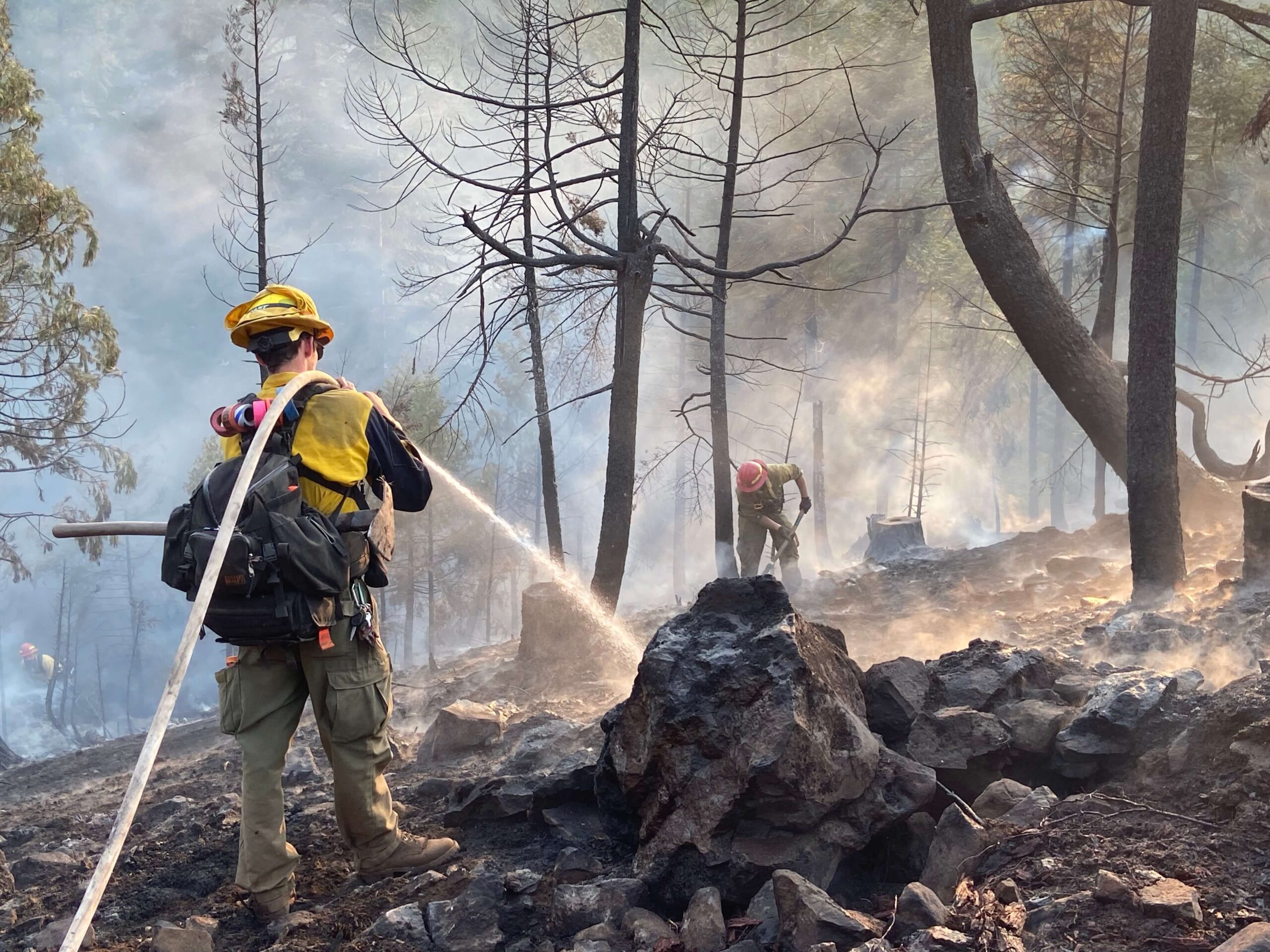
high-tech tools available to fire managers today, the basic hand crew still
plays an essential role in firefighting. In hardhats and yellow fire shirts,
these ground firefighters trudge across rugged terrain building fire line the
old-fashioned way, with shovels and Pulaskis.
In addition to agency hand crews, ODF and the other wildfire
departments of the Pacific Northwest have 173 private contract fire crews
available this season. These 20-person crews will be dispatched as needed to
large fires wherever they occur in the region.
Thirty inmate firefighting crews and nine camp/kitchen crews
will come online shortly for dispatch to fires. Through a long-standing
arrangement with the Oregon Department of Corrections (DOC), ODF trains and
fields 10-person inmate fire crews to perform initial attack on newly reported
fires. Drawn from correctional facilities throughout the state, these crews
also see action on large, extended-attack fires. While the fire crews are busy
on the fire line, specially trained inmate camp crews staff ODF’s mobile
kitchens, cranking out six meals a day to feed two shifts of firefighters.
Fire engine crews
Department of Forestry district offices completed the annual
training and hiring of fire engine crews in March. The mission of these
seasonal employees is to put out newly reported fires quickly at small size.
They do their job so well that most Oregonians don’t know the engine crews
exist. They play a major role in helping ODF meet its policy objective to put
out 97 percent of all fires at 10 acres or smaller.
Fire teams
ODF maintains three special teams on call to manage large
wildfires. When the members receive the dispatch call they drive through the
night from locations throughout the state, set up a tent “city” in the forest,
and go to work the next morning. The military-sounding job titles – air
tactical group supervisor, liaison officer, et al – hint at the nature of the
team’s mission: organize and manage a firefighting operation consisting of
hundreds of personnel and a baseball field-sized assemblage of heavy equipment
and hardware. Once the fire has been contained, district forces take over and
the team members head home to their regular jobs.
Landowner firefighters
Oregon’s forest landowners have been key partners in
Oregon’s collaborative fire protection system for more than a century. While
support from all forest landowners is valuable, many of the industrial
landowners maintain firefighting forces that include woods workers and heavy
equipment ranging from fire engines to bulldozers, on up to helicopters. Forest
landowners are intimately familiar with the land, including the location of
critical wildlife habitats. The knowledge and
expertise of their logging and silvicultural contractors comes into play as
well when a fire breaks out.
Forecasting fire
Dry lightning is the wild card in any Oregon fire season.
When thunderstorms produce numerous ground strikes but little rainfall,
hundreds of new fires can spring up instantaneously. Dry lightning events are
hard to forecast. But when meteorologists see strong potential, they notify
fire managers, who may order “move-ups” of aircraft, fire engines and crews to
areas likely to be affected. These additional resources help local forces
attend to the new fires quickly before they can grow into major incidents.
Smoke cameras
Forest lookouts still serve a purpose in some forest
locations. But ODF has found that “intelligent” smoke-detection cameras can
take the place of human watchers in many areas at reduced cost. These automated
video cameras are programmed to scan the forest for signs of smoke. When they
find it, a sophisticated computer application interprets the image. If it comes
up positive (not clouds or fog), the finding is then displayed as an alarm,
prompting a human operator, who makes the final determination.
Applications Due Friday for Josephine County Land Steward Class
Oregon State University Extension Service is offering its Land Steward program in Josephine County this summer. The classes are held in the field and begin May 15, and are held every Wednesday until June 19. Classes start at 3:00 p.m. and end at 6:00 p.m.
This program is designed for small-acreage landowners so they may learn about creating a healthy environment on their properties through site visits, mentoring and the creation of a personalized management plan. The course targets landowners who want to learn to balance sustainability with their rural lifestyles.
Land Stewards learn how to:
The class costs $100 for individuals or $150 for couples.
Contact the OSU Extension Land Steward Coordinator Rhianna Simes at (541) 776-7371 ext. 213. Applications are due Friday, May 10.
This program is designed for small-acreage landowners so they may learn about creating a healthy environment on their properties through site visits, mentoring and the creation of a personalized management plan. The course targets landowners who want to learn to balance sustainability with their rural lifestyles.
Land Stewards learn how to:
- Live safely in a wildfire-prone area
- Reduce yard waste and woody biomass
- Identify and eradicate noxious weeds
- Make their own mulch and compost
- Promote and develop wildlife habitat
- Maintain healthy trees and forests
- Conserve water and reduce runoff
The class costs $100 for individuals or $150 for couples.
Contact the OSU Extension Land Steward Coordinator Rhianna Simes at (541) 776-7371 ext. 213. Applications are due Friday, May 10.
Monday, May 6, 2013
Lightning Fire Update
A reconnaissance flight today discovered a handful of new lightning-caused fires in ODF's Southwest Oregon District, mostly in Josephine County. A few smokes were spotted in Jackson County but they were determined to be on National Forest land, which is protected by the Rogue River-Siskiyou National Forest.
Josephine County fire summary:
- Two fires in the Sleepy Hollow area, .10 acre and .01 acres
- Rocky Gulch, 3 acres
- Robinson Gulch, 1 acre
- Peggler Butte, 1 acre
- Copper Queen, .50 acre
- Lower Grave Creek, .10 acre
- Two fires in the Last Chance area, .10 and .01 acres
- Quartz Creek, .10 acre
Lightning Peppers SW Oregon Forests
A Sunday afternoon thunderstorm sparked 13 fires on ODF-protected lands in Jackson and Josephine counties. The largest of the fires is the 5-acre Yellow Rock #2 fire, located in the Elk Creek drainage. The other fires on ODF's Medford Unit include:
More lightning is predicted for the area later today.
- Yellow Rock #1, .01 acre
- Berry Rock #1, .25 acre
- Berry Rock #2, .10 acre
- Berry Rock #3, .10 acre
- Point Mtn., .01 acre
- Anderson Butte, .01 acre
- Rocky Gulch, 2 acres
- Sleepy Hollow, .10 acre
- Bolt Mtn., .01 acre
- Peggler Butt, size unknown
- Stratton Creek, size unknown
- Copper Queen, size unknown
More lightning is predicted for the area later today.
Friday, May 3, 2013
Use Care When Burning Debris
Nearly two weeks of above-average temperatures and zero rain has left much of the Rogue Valley bone dry. Firefighters from the Oregon Dept. of Forestry's Southwest Oregon District and most of the rural fire protection districts have extinguished escaped burn pile fires almost every day in that period of time.
Before burning, call the air quality opening burning advisory line for your county to find out whether opening burning is permitted on that day.
Check the weather. If the temperature is 80 or above, strongly consider burning on a cooler day. If strong or gusty winds are in the forecast, don't burn.
Have water readily available at your burn pile site. Test hoses to make sure they work, and add enough hose to stretch at least 50 feet beyond your pile site. And keep a shovel close by.
Never leave a flaming burn pile unattended. Ever. Not even for a minute.
It's best to burn early in the day, and always complete the burning project before nightfall. Use water and a shovel to soak down remaining embers, and stir them with wet dirt to completely extinguish every last spark. Check the burned area the next day to make sure no smoking debris is left.
If your burn pile fire escapes your control, call 9-1-1 immediately.
We need your help to Keep Oregon Green.
Before burning, call the air quality opening burning advisory line for your county to find out whether opening burning is permitted on that day.
- Jackson County: (541) 776-7007
- Josephine County: (541) 476-9663
Check the weather. If the temperature is 80 or above, strongly consider burning on a cooler day. If strong or gusty winds are in the forecast, don't burn.
Have water readily available at your burn pile site. Test hoses to make sure they work, and add enough hose to stretch at least 50 feet beyond your pile site. And keep a shovel close by.
Never leave a flaming burn pile unattended. Ever. Not even for a minute.
It's best to burn early in the day, and always complete the burning project before nightfall. Use water and a shovel to soak down remaining embers, and stir them with wet dirt to completely extinguish every last spark. Check the burned area the next day to make sure no smoking debris is left.
If your burn pile fire escapes your control, call 9-1-1 immediately.
We need your help to Keep Oregon Green.
Subscribe to:
Posts (Atom)